

The Paris Blockchain Week 2026 marked a decisive shift in the European blockchain and digital asset landscape. What once began as a space defined by experimentation and innovation is now evolving into a domain of infrastructure, regulation, and institutional integration.
Across discussions with policymakers, financial institutions, technology leaders and regulators, one message became increasingly clear:
Europe has entered the next phase of blockchain development.
This phase is no longer about defining the potential of the technology.
It is about operationalising it.
From Regulation to Implementation
With the full application of the Markets in Crypto-Assets Regulation (MiCA) in December 2024, Europe has established the world’s first comprehensive regulatory framework for digital assets. Markets in Crypto-Assets Regulation (MiCA)
This represents a significant achievement in providing legal certainty, investor protection and a harmonised market environment across Member States.
However, as discussions at Paris Blockchain Week highlighted, regulation alone does not create competitiveness.
The next challenge for Europe lies in translating regulatory clarity into operational capability — across custody, settlement infrastructure, cross-border execution and institutional adoption.
A New Strategic Layer: Infrastructure and Sovereignty
A second key theme emerging from Paris is the growing importance of blockchain as a strategic infrastructure layer, rather than a standalone innovation domain.
This is particularly evident in the debate around:
- euro-denominated stablecoins
- tokenised deposits
- and the future of digital settlement systems
These developments reflect a broader shift:
blockchain is increasingly understood as part of Europe’s financial and digital sovereignty architecture.
At the same time, the long-standing tension between decentralised systems and European data protection frameworks is beginning to evolve. Recent regulatory developments, including new guidelines on GDPR application to blockchain-based systems, signal a more technically grounded and forward-looking approach.
From Pilots to Production
Another structural insight from Paris Blockchain Week is the transition of tokenisation from pilot use cases to production-ready infrastructure.
Tokenised real-world assets, interoperable identity systems and privacy-preserving architectures are no longer conceptual discussions. They are increasingly becoming prerequisites for institutional-scale deployment.
This transition introduces a new set of requirements:
- interoperability standards
- common data models
- trusted infrastructure frameworks
- and scalable governance mechanisms
Without alignment in these areas, Europe risks fragmentation across jurisdictions, sectors and technical implementations.
Coordinating Europe’s Blockchain Ecosystem
Europe’s strength has always been its ability to define regulatory frameworks grounded in values such as transparency, accountability and fundamental rights.
Its challenge, however, remains coordination.
The European Blockchain Association (EBA) has consistently emphasised the importance of aligning stakeholders across industries, regions and governance levels. In a landscape that is inherently decentralised, fragmentation is not only a technical risk — it is a strategic one.
As blockchain ecosystems mature, the need for neutral platforms that facilitate coordination, standardisation and dialogue becomes increasingly critical.
Actions for Europe
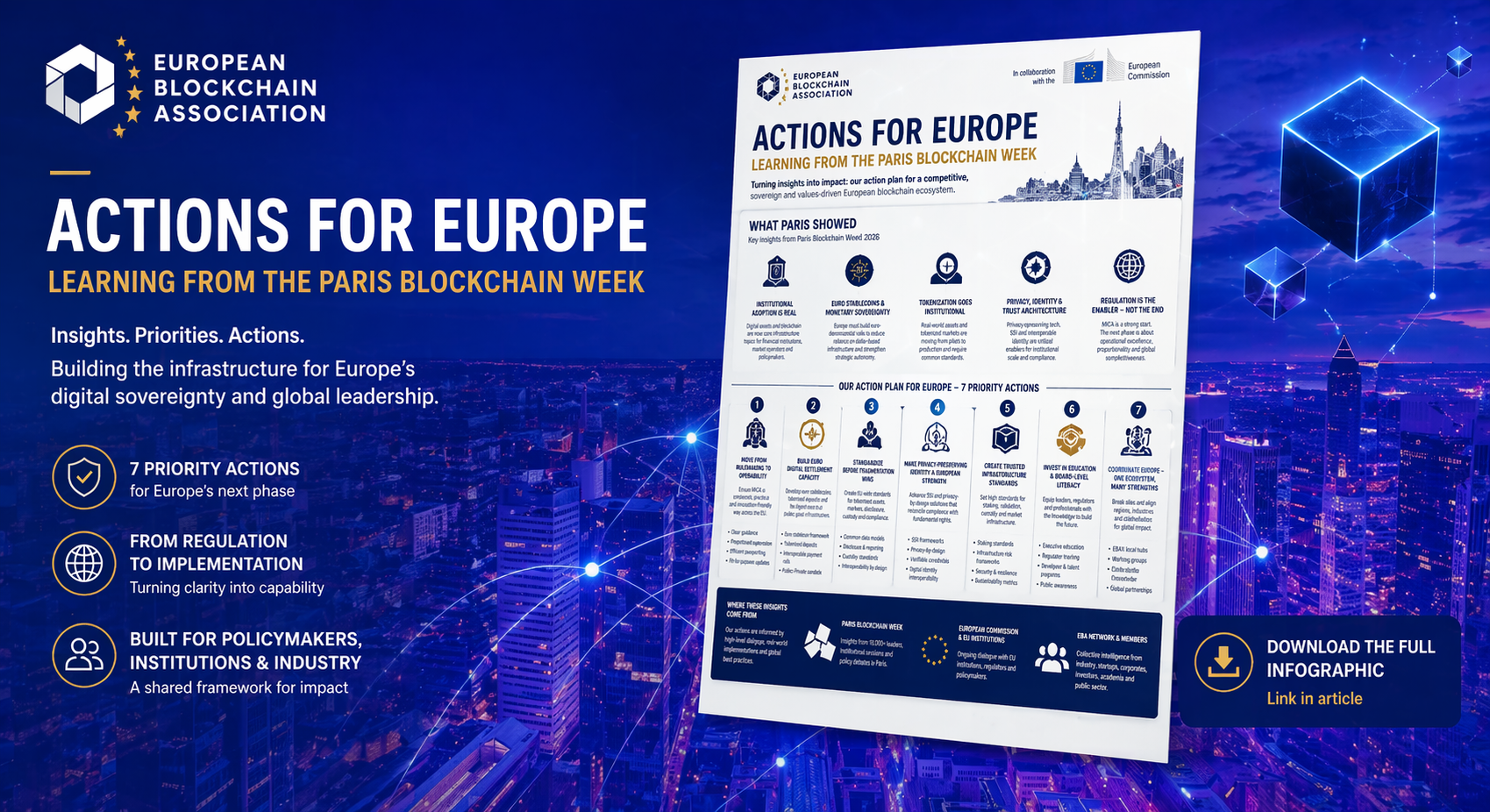
In response to the insights emerging from Paris Blockchain Week, the European Blockchain Association has developed a strategic action framework outlining seven priority areas for Europe’s next phase of blockchain development:
- Moving from rulemaking to operability
- Building euro-denominated digital settlement infrastructure
- Standardising tokenisation frameworks
- Advancing privacy-preserving identity systems
- Establishing trusted infrastructure standards
- Strengthening education and board-level literacy
- Coordinating Europe’s ecosystem across sectors and borders
These actions are intended not as abstract recommendations, but as a practical foundation for policymakers, institutions and industry leaders working to translate Europe’s regulatory leadership into global competitiveness.
From Insight to Impact
Europe has taken a leading role in shaping the regulatory foundations of the blockchain economy.
The opportunity now lies in building on this foundation — by developing the infrastructure, coordination mechanisms and institutional capabilities required for large-scale adoption.
To support this process, the European Blockchain Association has published a comprehensive infographic:
“Actions for Europe — Learning from the Paris Blockchain Week”
The infographic provides a structured overview of key insights and priority actions and is designed to support internal discussions, strategic planning and policy dialogue across Europe’s blockchain ecosystem.
Download
The full infographic is available for download

We invite policymakers, institutions, and ecosystem stakeholders to use, share and build upon this framework as part of a collective effort to strengthen Europe’s position in the global blockchain landscape.